


 Market Data

Bankless co-founder David Hoffman sold his Ethereum ($ETH) holdings. He argues the “$ETH is money” thesis has fully played out. On-chain data and the daily chart suggest the market is already pricing in his call.
Ether trades around $1,975, down 2.4% on the day and roughly 14% over the past month. Active addresses are falling, and exchange balances are rising again. Both echo the fade Hoffman described in his exit note.
Why David Hoffman Sold His $ETH
Hoffman called the “$ETH is money” thesis a long shot. He argued it required every Ethereum layer to outperform rivals. According to him, that bar was missed.
The Bankless co-founder stresses he remains bullish on the Ethereum network. However, he sees no structural rerating ahead for $ETH as an asset. The protocol returns value to L2s and apps rather than capturing it.
I spent the weekend putting my thoughts about $ETH and Ethereum into this article
I built my career, community, and business on Ethereum, so the decision to sell deserves a deeper explanation
I hope this is sufficient
Thank you, all
— David Hoffman (@TrustlessState) May 26, 2026
His sale drew wide coverage across crypto. Hoffman has been one of the loudest Ethereum advocates of the past five years. The reaction split the market. Some traders agree the thesis has run its course. Others still see $ETH as a discounted bet on Web3.
Declining Active Addresses Confirm Fading Network Demand
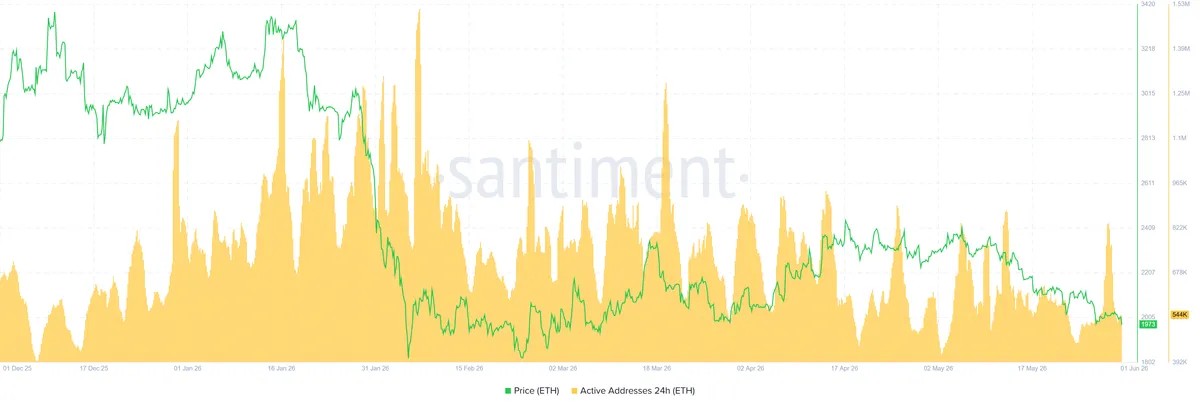
Daily active addresses on Ethereum have trended lower since early February, according to Santiment data. The metric peaked above 1.5 million in January. It now sits near 544,000.
This fade tracks the broader drawdown from above $3,400 in early December to under $2,000 today. Hoffman argues that L1 assets are ultimately priced on fees and revenue. Fees only flow when users keep transacting on the base layer.
In his exit note, Hoffman pointed to Solana’s 2024 rerating and NEAR’s 2026 move. Both showed that L1 token strength correlates with fee market share. Ethereum lost that share through 2024 and 2025.
He also referenced BNB and TRX, two of the highest-grossing chains. Their charts behave as he expected $ETH would after 2022. The takeaway is that fee dominance, not technology, sets the ceiling.
A reversal in the trend would weaken the signal. Addresses would need to push back above one million on a 30-day rolling average. Until then, the on-chain backdrop matches Hoffman’s bearish call.
Demand is fading while activity migrates to L2s. Those L2s pay almost nothing back to the Ethereum base layer.
Exchange Supply Reverses, Sellers Return After Months of Accumulation
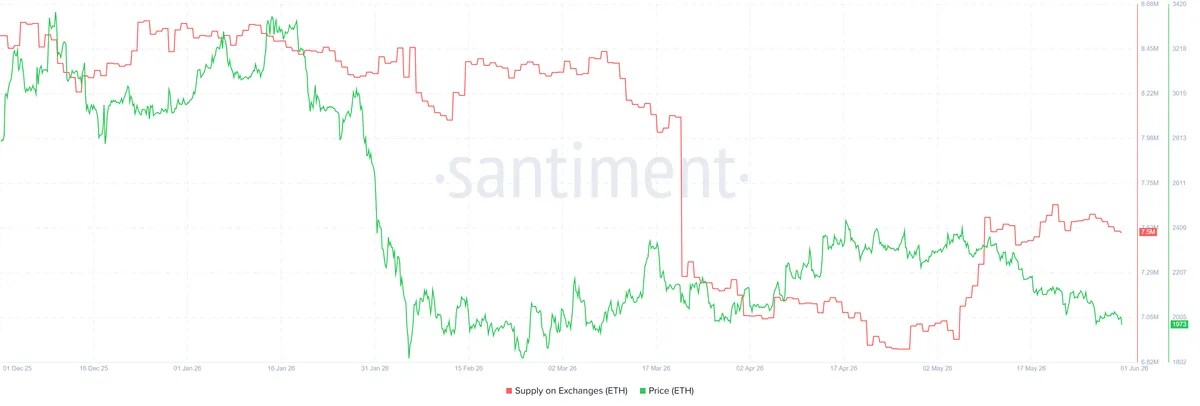
The second on-chain signal cuts a more interesting shape. $ETH supply on exchanges dropped sharply in late January, from roughly 8.5 million to about 7 million. That low held through April. The stretch looked like a quiet accumulation.
However, the trend has flipped in May. Supply on exchanges has climbed back to 7.5 million. It now holds steady at that level. Coins moving back to exchanges typically signal that holders are positioning to sell.
The rotation is small in absolute terms but directionally important. It coincides with the breakdown below $2,140 on the daily chart. It also overlaps with the renewed downtrend in active addresses.
Hoffman argues that bullish on-chain phases for $ETH eventually fade. The network is architecturally a “giver, not a taker.” The May reversal in exchange supply is consistent with that view.
Holders who accumulated through the dip are now distributing into weakness. They are not waiting for a structural rerating.
The behavior also lines up with the stablecoin point in Hoffman’s piece. Ethereum settles $163 billion in stablecoins today, up from $3 billion in 2020. That utility helps the dollar more than it helps $ETH. Holders appear to be reading the same memo.
Net exchange inflows tend to lead to price weakness by several weeks. If the May trend continues into June, $ETH may see fresh selling pressure even before the daily chart breaks. The Q1 accumulation case no longer carries the same weight.
$ETH Price Prediction Points to $1,920 Channel Floor
The daily chart shows $ETH trapped inside a descending parallel channel since late April. Price was rejected from the 0.382 Fibonacci retracement at $2,382 in early May. It then lost the 0.236 level at $2,140 in mid-May.
$ETH currently trades at $1,978 and is grinding toward the lower channel band. That zone aligns with the next visible support near $1,920. A clean break below opens the path toward $1,750, the previous swing low and the 0 Fibonacci anchor.
Volume has been declining since early February. The drop signals weak conviction from both buyers and sellers. Meanwhile, the 14-day RSI sits near 30 and is stepping into oversold territory.
Historically, RSI prints below 30 on $ETH have produced sharp counter-trend rallies. However, those rallies often reset before the broader trend resumes. Therefore, traders should watch for a wick into the $1,920 zone followed by a daily reversal candle.
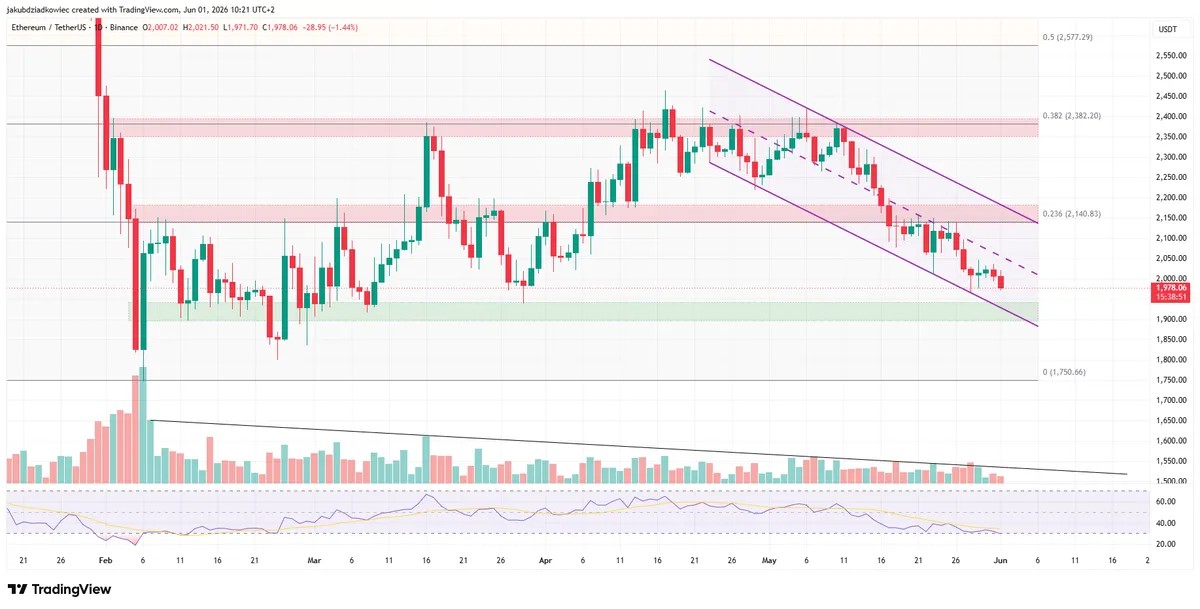
The setup that would flip the bias bullish is a daily close above $2,140. That move would reclaim the 0.236 Fibonacci level and open a push through $2,382. Until that happens, every rally fades inside the descending channel.
A bounce from $1,920 on rising volume would buy time for bulls. A close below would confirm Hoffman’s structural read on the tape. It would also put $1,750 on the table.
A retest of $1,750 would mark $ETH’s lowest print of 2026. It would also wipe out months of accumulated work by spot holders. Bulls need the $1,920 zone to hold cleanly to avoid that scenario.
For now, the channel, the on-chain tape, and Hoffman’s thesis form a coherent bearish stack. None of these signals is decisive alone, but together they pressure the same trade. Buying $ETH here is a bet that all three rotate at once.
Watching the $2,140 reclaim level is the cleanest way to test whether bears or bulls control the next move. Until that level prints on a daily close, the burden of proof sits with the bulls, exactly as Hoffman’s note “Why I Sold My $ETH” implied.
Read the full article here


