


 Market Data

Perpetual futures are entering regulated markets, and the objection to them is serious: retail-driven, high-leverage instruments will import systemic risk. But the critique is aimed at the wrong target. Systemic risk in a derivatives market is a property of the venue on which the perpetuals are traded, not the contract. The risk is set by venue choices: leverage caps, margin, funding design, default management. None inherent to a no-expiry contract.
The concern isn’t baseless. Crypto’s sharpest deleveraging episodes — with the October 2025 cascade among the most recent — have many causes: macro shocks, stablecoin de-pegs, exchange outages, oracle failures, over-leverage and thin liquidity. What turns a sell-off into a systemic event is the risk transmission mechanism, and in crypto that is usually the liquidation cascade: forced liquidations depress prices, transmit to other venues through shared reference pricing and arbitrage, and trigger more liquidations. What makes the cascade violent are venue choices: a manipulable index that liquidates on false prices, and auto-deleveraging that claws back profitable trades to cover a shortfall. Neither is a feature of perpetuals.
Chris Tyrer is the President of Bullish Exchange. Tram Doman leads product marketing at Bullish Exchange. Bullish has filed with the CFTC for designation as a Designated Contract Market (DCM) and for registration as a Derivatives Clearing Organization (DCO).
So the real question is not whether perpetuals belong in regulated markets; it is how a given venue is built. Regulatory requirements are necessary to secure the baseline: segregated funds, a registered clearing entity, a supervisor’s oversight. How a venue handles a default under stress is a separate choice, and it varies even inside the regulated perimeter.
There’s a sharper objection worth taking seriously, and it isn’t about risk: maybe institutions don’t want perpetuals at all. A recent JPMorgan note found limited institutional appetite for perpetuals, treating them as speculative rather than a replacement for regulated futures – no term structure, and basis risk that makes them imperfect substitutes. That is correct when it comes to the mechanics: as a substitute for dated futures, perpetuals fall short. Unlike a futures basis, funding is variable and can’t be locked in; and for a hedger who needs term structure and delivery, they are the wrong tool.
But replacement is not how institutions reach for them. Running both an options market and a perpetual one, Bullish sees it firsthand: many of the institutions trading options on our venue use perpetuals to hedge delta (the options’ directional exposure to the underlying’s price), not as a stand-in for dated futures, but because that is where the liquidity is. Term structure is less relevant to delta hedging than liquidity. Many of crypto’s dated futures are thinly-traded, while perpetuals — liquid in part because of the retail flow their critics deride — are the deepest, most continuously tradable delta-one instruments available. A desk managing risk in real time takes execution over elegance.
And that liquidity edge is structural. Retail gravitates to perpetuals for what they are: no expiry, no roll, continuously tradable. The design that draws that flow concentrates liquidity in perpetuals. That is the overlooked prize in bringing perpetuals onshore: a deep, durable pool of liquidity in the instruments a hedging desk wants.
So the two halves of the debate are one. The liquidity institutions want already exists, drawn in large part by retail. What lets them use it safely is institutional-grade default management, the same thing that contains the systemic risk the critics fear.
The question was never “are perpetuals dangerous?” It is “when the market is under stress, how does a venue handle a default?” Regulated clearing has established the standard for decades, which is also the standard Bullish is building toward, having filed with the CFTC to operate as a regulated contract market and clearinghouse.
When a liquidation’s shortfall outruns the insurance fund, the backstop is to socialize losses: auto-deleveraging force-closes offsetting profitable positions at an off-market price in order to absorb the defaulter’s loss. The clearing model works differently. It starts with the defaulter, whose own margin and fund contribution absorb the first loss. The position is worked off through the order book or, if large, auctioned to other clearing members. Behind that sits a pre-funded guaranty fund sized to regulated clearinghouse standards, with broad loss-sharing only beyond that, and rarely.
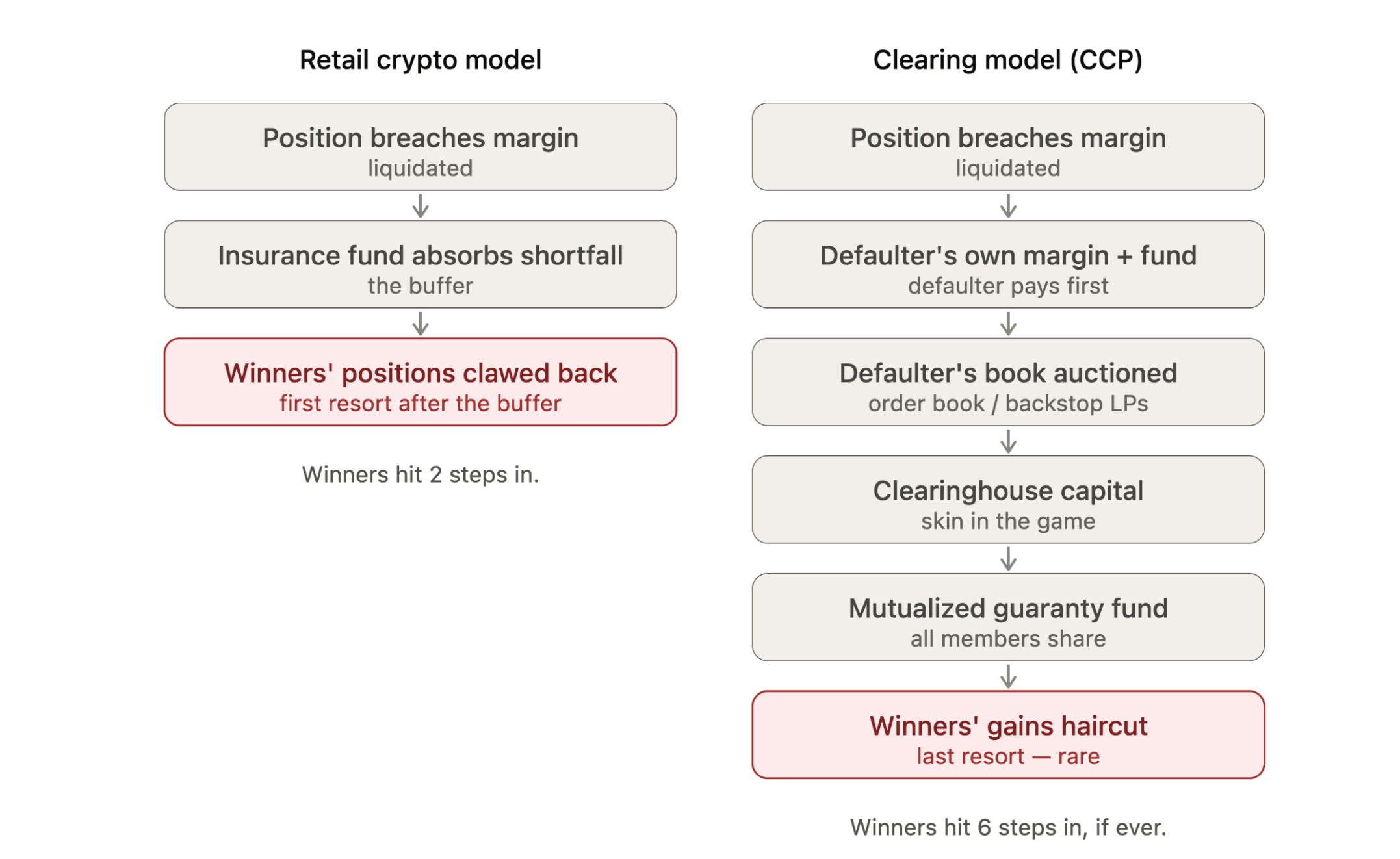
None of this completely eliminates risk – nothing does. What it does is break the chain that turns one blown-out account into a market-wide cascade: a default absorbed at its source, not force-fed into a falling market. That is the difference between a venue that contains a failure and one that transmits it, and the transmission is the systemic risk the critics fear. Meet that standard and perpetuals become infrastructure institutions can use; miss it and we have the hazard critics describe, regulated or not. Perpetuals were never the whole story. The design is.
Read the full article here