


 Market Data

Using one current finalized accounting sample, an illustration puts the execution base fee needed to offset gross issuance at about 13.85 gwei with today’s 60 million gas limit, or 4.16 gwei with a hypothetical 200 million limit.
Both require roughly 2,992 $ETH of daily burn under the model’s assumptions.
What the 2026 ledger shows
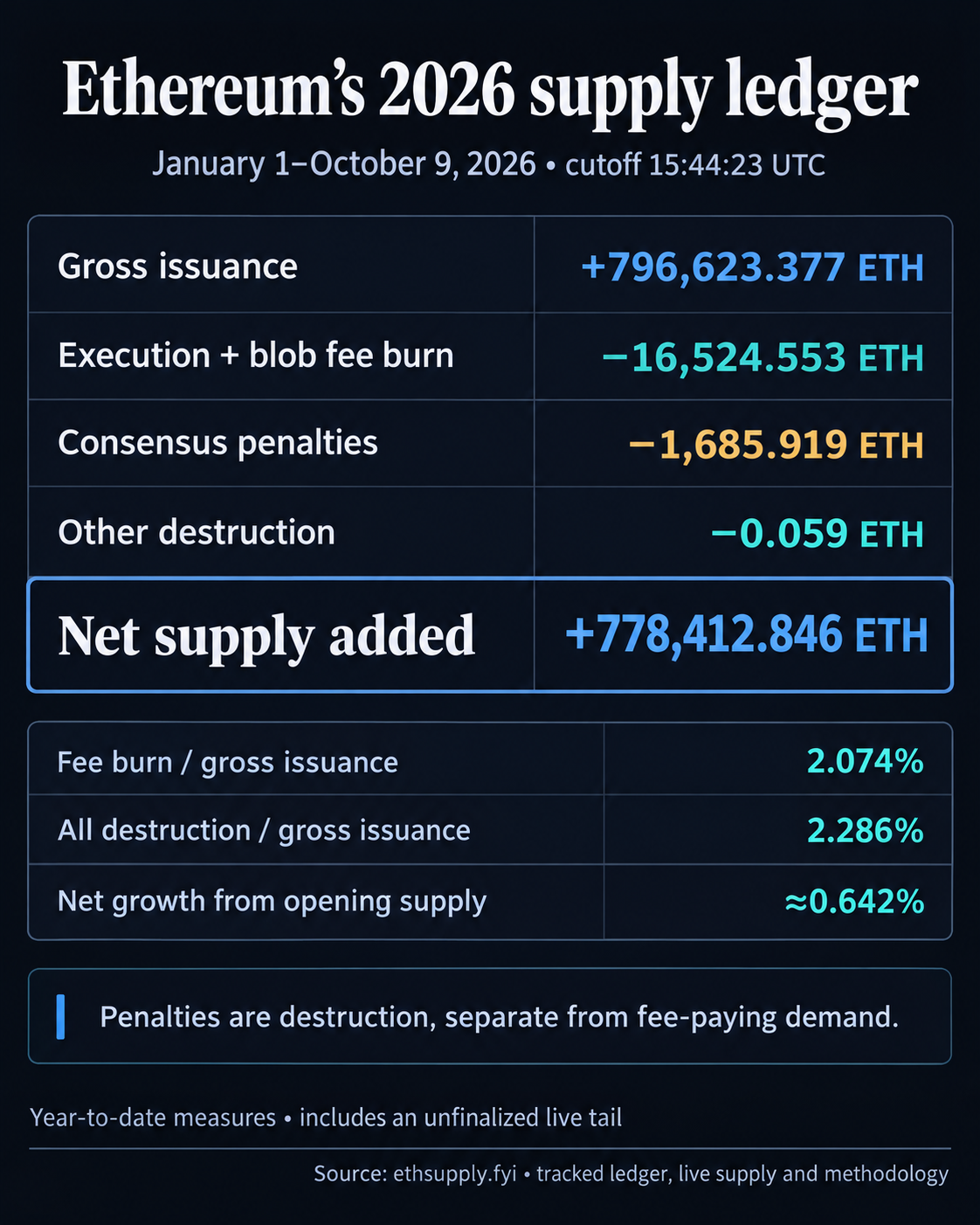
The ethsupply.fyi retained ledger covers Jan. 1 at 00:00:11 UTC through Oct. 9 at 15:44:23 UTC. It reports 796,623.377 $ETH of gross issuance against 16,524.553 $ETH destroyed through execution and blob transaction fees.
A further 1,685.919 $ETH was removed through consensus penalties, with 0.059 $ETH in other execution destruction. Subtracting these components leaves 778,412.846 $ETH in net additions.
Those categories explain why the fee-burn offset is 2.074%, while the offset from all destruction is 2.286%. The latter includes penalties that do not represent customers paying for Ethereum activity. Treating the larger figure as transaction-fee demand would overstate how much issuance users have offset.
The provider’s methodology separates newly created validator rewards from execution base fees, blob fees, penalties, and rare destruction through SELFDESTRUCT. Transfers, staking deposits and withdrawals preserve supply while moving existing $ETH between accounts or accounting layers.
Its same-cutoff supply snapshot reports approximately 122.116 million $ETH. Subtracting the net additions implies about 121.338 million $ETH at the window’s opening, producing the roughly 0.64% increase.
The 2.074% offset covers the cumulative 2026 window, while a current daily burn rate would require a separate daily comparison.
Ethereum’s EIP-1559 fee mechanism burns the execution base fee on gas actually consumed. Priority fees go to block producers. Blob base fees also destroy $ETH, while MEV payments and application revenue do not automatically become protocol burn.
The base fee, quoted in gwei, determines the $ETH burned for each unit consumed. With an elasticity multiplier of two, a 60 million gas maximum corresponds to a 30 million target. A hypothetical 200 million maximum would imply a 100 million target if that rule remains unchanged.
A finalized mainnet beacon block at slot 15,394,656 contains execution block 26,155,767, timestamped Oct. 9 at 15:31:35 UTC, with a 60 million maximum. The matching execution-block record shows a base fee of approximately 0.335 gwei.
The supply consequence depends on consumed gas multiplied by its base fee, plus blob burn and other destruction. An unused increase in capacity cannot burn $ETH, nor does a larger transaction count by itself establish greater burn if the transactions require less gas or pay lower base fees.
CryptoSlate’s Oct. 1 coverage already concluded that Ethereum’s 200 million gas target is conditional, validator-dependent, and not an automatic new limit. A Sept. 23 fee comparison highlighted the missing matched-period issuance denominator.
The same burn budget at two limits
For a current illustration, ethsupply.fyi’s finalized-epoch accounting snapshot for epoch 481082, as of Oct. 9 at 15:31:23 UTC, records 13.296472924 $ETH of gross issuance over 32 slots. At 12 seconds per slot, that is a 384-second sample.
The calculation holds that issuance pace constant, assumes every slot produces a block and consumes gas at the target, and initially sets blob burn, penalties, and other destruction to zero. The resulting thresholds describe the execution base-fee burn needed to offset gross issuance under those assumptions.
The daily figure extends the single sample across 225 epochs, with the resulting daily burn budget applying to this hypothetical day. Daily issuance and burn would require a full day’s observations, as the larger gas target lowers the required base fee because the same $ETH budget is divided across more consumed gas.
The more complete zero-net-growth calculation credits the sample’s 0.016575391 $ETH of penalties and 0.000442673483 $ETH of blob burn. Holding those amounts constant lowers the execution thresholds slightly, to about 13.83 gwei and 4.15 gwei. The corresponding total transaction-fee burn budget after penalties is approximately 2,988 $ETH per modeled day.
If gas consumed stays unchanged when the maximum rises, the balancing fee does not fall. The half-target row illustrates the arithmetic sensitivity to consumed gas, but EIP-1559 reduces base fees over successive blocks when consumption remains below target.
The live provider snapshot reports approximately 43.754 million $ETH in active effective stake across 853,325 active validators. Ethereum’s supply explanation identifies staking participation as a determinant of issuance, so a future threshold needs a fresh issuance sample alongside gas and blob usage.
Glamsterdam is a capacity scenario
The Ethereum Foundation’s May 11 protocol update described 200 million gas as a credible post-Glamsterdam target. The upgrade’s proposer-builder separation and block-level access lists aim to support greater throughput, alongside changes to gas accounting.
The Foundation’s testnet announcement on Sept. 28 scheduled Sepolia for Oct. 6 at 13:53:36 UTC while leaving Hoodi and mainnet activation dates undecided. The official roadmap leaves the mainnet date unconfirmed.
Changes to the gas charged for execution and state growth mean a gas unit may buy different work after the upgrade. The modeled limits cannot be translated directly into proportionally more identical transactions, users, or burned $ETH.
For holders, the relevant signal is whether burned fees and other destruction approach or exceed issuance over a matched interval. More available gas creates room for activity, but the shrinking-supply case needs that activity to generate enough aggregate burned fees.
Layer-2 (L2) blockchain growth and staking balances distinguish from fresh $ETH purchases and settlement spending. The same distinction applies here, since existing holders can stake, and applications can grow, without those measures alone establishing the required burn.
The October ledger shows supply increasing while developers work toward greater capacity. A sustained shift toward shrinking supply would appear in consumed gas, execution base fees, blob burn, and stake-dependent issuance together.
Read the full article here