


 Market Data

The firm added: “$XRP has fallen more than 9% over the past week, with leveraged longs getting flushed and the $1.40 area proving difficult to reclaim.”
Bitcoin’s bearish tone came after repeated rejection near $87,000, a retreat toward $81,000, and heavy long liquidations, with broader economic pressure also weighing on confidence. The shift followed bitcoin’s earlier positive sentiment spike on Sept. 21, its strongest since December 2024, when the cryptocurrency exceeded $87,300.
Both readings sit below the 1.0 threshold where bullish and bearish comments would be equally numerous. Ethereum’s earlier sentiment ratio of 0.89 on Oct. 1 was also below parity, before ether became the crowd favorite on social media.
$XRP’s September rally coincided with increased activity on its blockchain before the latest price downturn. As the token crossed $1.60 on Sept. 22, Santiment counted 1,917 $XRP transactions worth at least $100,000. Large transfers can represent purchases, sales, or movements between wallets. The same update logged 3,647 new wallets on the $XRP Ledger.
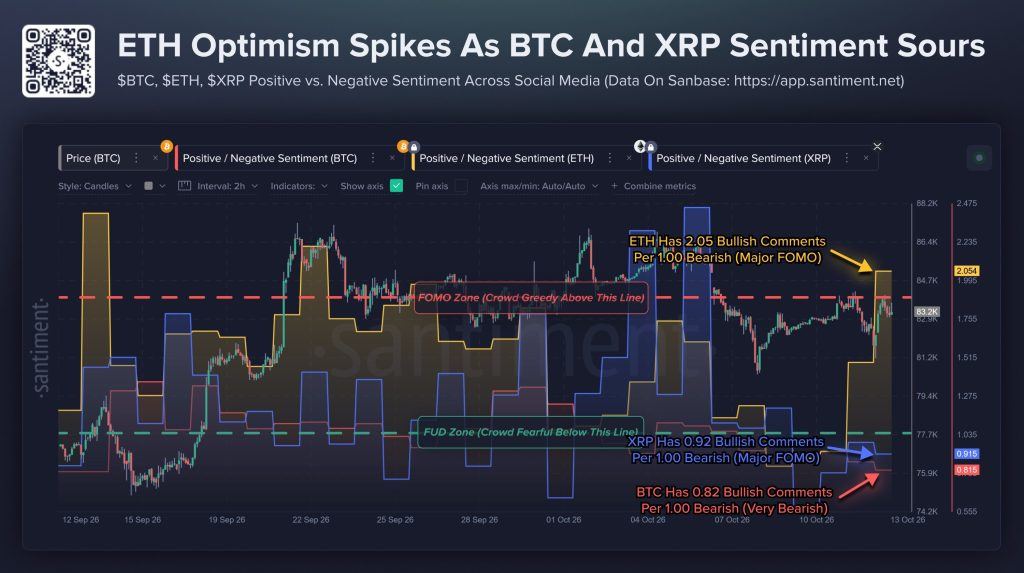
Ethereum Optimism Contrasts With $XRP and Bitcoin Fear
Ethereum attracted 2.05 optimistic remarks for every pessimistic one, a result Santiment characterized as fear of missing out, or FOMO. The firm associated that enthusiasm with a rebound above support, staking demand, and expectations for network improvements.
Santiment offered a contrarian interpretation:
“From a contrarian perspective, BTC and $XRP’s fear is healthier than $ETH’s crowd excitement if prices begin recovering.”
Ether, or $ETH, is Ethereum’s native cryptocurrency and pays transaction fees on the network. Validators stake $ETH to help secure the blockchain, which runs applications including decentralized exchanges and lending markets.
The company’s social sentiment calculations evaluate the language used in online discussions through models that classify bullish, neutral, and bearish messages. Confidence thresholds help filter the material included in the dataset. These measures describe expressed attitudes toward an asset, providing a separate perspective from executed trades and transfers recorded on a blockchain.
Read the full article here