






 Market Data

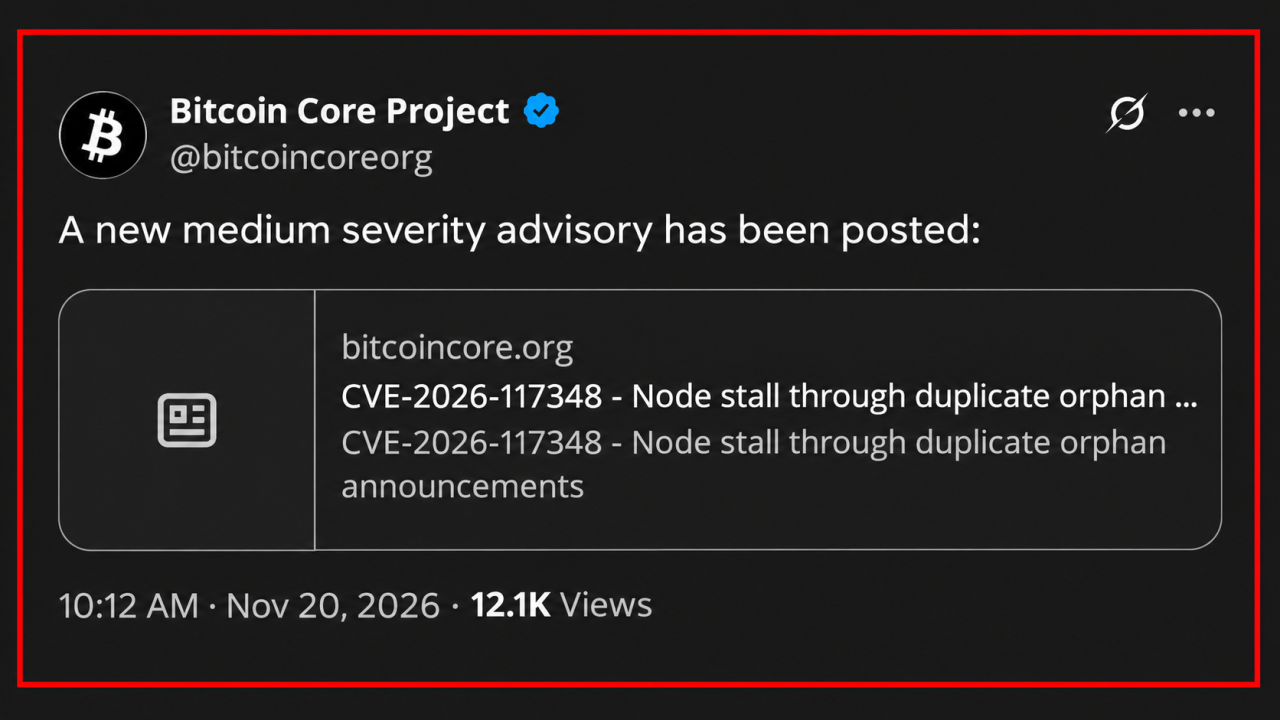
The vulnerability exploited an overlooked inefficiency in that process. Bitcoin inventory messages can contain 50,000 entries, yet the software failed to disregard duplicate transaction announcements. An attacker could repeatedly reference an orphan transaction with thousands of missing parents, forcing the receiving node to perform the same computationally expensive checks thousands of times.
Each manipulated message could stall processing for more than 12 seconds, leaving the targeted node temporarily unable to handle incoming blocks or other network communications.
The discovery originated with Project Loupe, an automated large language model (LLM) security initiative developed by Elias Rohrer at Spiral, Block’s open-source Bitcoin development division. Bitcoin Core developer Gregory Sanders subsequently validated the finding and brought it to the project’s security team.
Project Loupe reported the vulnerability on July 8. An independent researcher identified as Stutxo submitted a separate report on Aug. 4, the same day Sanders opened a corrective pull request. Developers merged the fix on Aug. 6, and Bitcoin Core 32.1 incorporated it on Oct. 27.
The Nov. 20 disclosure accompanied updated releases for maintained older branches. The correction ensures each unique transaction announcement is processed only once per inventory message.
Although the flaw permitted temporary denial-of-service attacks, the advisory did not establish any mechanism for stealing bitcoin or permanently damaging nodes.
AI Security Research Exposes Long-Standing Blockchain Weaknesses
The disclosure arrives amid an extraordinary year for AI-assisted vulnerability research across cryptocurrency infrastructure.
In February, an AI-assisted review identified a critical signature-verification weakness in the XRP Ledger’s proposed Batch amendment before activation. Another investigation uncovered a high-severity vulnerability in Nethermind, an Ethereum execution client, potentially affecting validator operations.
By late May, researcher Taylor Hornby had used an AI-assisted auditing system to identify a four-year-old flaw in Zcash’s Orchard privacy protocol. The vulnerability could have permitted undetectable counterfeit ZEC, although developers corrected it before public disclosure.
August brought another striking demonstration. Sixteen volunteer developers participating in a Bitcoin security initiative generated 4,962 findings across 390 projects in approximately one day, including 85 initially classified as critical.
However, automated discovery introduced considerable complications. Maintainers faced thousands of reports requiring human verification, while legitimate security concerns competed with false positives and poorly substantiated findings.
Core Lightning developers also confronted an influx of AI-generated vulnerability reports, ultimately identifying genuine security problems requiring corrective releases.
The implications extend beyond defensive research. Security specialists have raised concerns that malicious actors can employ similar technology to uncover weaknesses in older software, potentially shortening the useful lifespan of traditional security audits.
Bitcoin Core Accelerates Disclosure as AI Changes Security Research
Recognizing this development, Bitcoin Core revised its vulnerability disclosure policy in October. Issues classified as easily discoverable, including weaknesses identifiable through relatively simple LLM-assisted analysis, now receive accelerated public disclosure alongside corrective releases.
CVE-2026-117348 illustrates that approach in practice.
The episode also exposes a difficult security paradox. AI can identify overlooked vulnerabilities faster than conventional research, but its growing accessibility potentially gives attackers comparable capabilities. For open-source cryptocurrency infrastructure, the central challenge is increasingly not merely discovering weaknesses, but validating and correcting them before adversaries exploit the same knowledge.
Read the full article here
