





 Market Data

The finish line was crossed last year. ZKsync shrank the machine
A proof, in this context, is a small cryptographic file confirming that every transaction in a block was processed correctly. Today, each Ethereum node checks a new block by running all of its transactions again on its own hardware. With a proof, a node could check that file instead, which takes very little computing power. The expensive work shifts to whoever generates the proof.
Speed alone is not the headline. In December 2025, the Ethereum Foundation said the industry had already hit its real-time target, after proving times fell from 16 minutes to 16 seconds within a year and costs dropped about 45 times. What ZKsync adds is the size of the setup. Its timings also include the target=”_blank” rel=”noopener”>real-time proving rules were never only about speed. They also capped hardware at $100,000 and power use at 10 kilowatts, so that some of the people who already run validators from home could generate proofs too. A million-dollar machine that proves blocks in five seconds would fail that test, because it would leave proving to a handful of large operators.
One workstation card sits far below that budget. That is why the result matters more for decentralization than for raw performance. If a single card can keep up with Ethereum, then producing proofs stops being a job only well-funded companies can do.
The numbers come from ZKsync’s own tests. The code is open, and the ETHproofs leaderboard lets outsiders follow live results, but no independent team has published a full reproduction yet.
Buterin’s congratulations came with a three-item to-do list
Buterin did not stop at praise. He argued that the industry should now put its effort into making these provers trustworthy, and he named three specific gaps.
The first is formal verification, a set of mathematical checks showing that the prover follows Ethereum’s official rules exactly, including rare edge cases that normal testing can miss. The second is a hard ceiling on proving costs, so that no block can be made deliberately expensive enough to prove that it stalls the network. The third is the security of the proof system itself, meaning confidence that the cryptography underneath cannot be tricked into approving something false.
A slow prover only delays things. A fast prover with a bug can approve something false. If a flaw lets an invalid block pass as valid, nodes that only check proofs would accept it, on a network holding hundreds of billions of dollars. The Foundation has already said it wants validators to check several independent proofs for each block, so that a bug in one system cannot slip through alone. That work tends to take years, not months.
For people using Ethereum today, nothing changes yet
Airbender Prime is a ZKsync product, not an Ethereum upgrade. Validators still check blocks the traditional way, and no one has set a date for proofs to replace that. The Foundation’s plan starts with optional software that validators can choose to run, and only later could it become standard.
If it does arrive, the main gain would be room to grow. Ethereum could handle more activity per block without forcing everyone who runs a node to buy stronger hardware. Faster proofs would not make transactions final faster, though, because the rest of the network process follows its own timing.
ZKsync is already using Airbender on its own chains that run the Atlas upgrade, and it is pitching the same technology to banks and companies through Prividium, its system for private blockchains that settle on Ethereum. For now, those private chains are where the prover makes money for ZKsync, well before Ethereum mainnet could use it.
The ZK token doubled, but the prover does not pay its holders
ZK is mainly a governance token. Fees on ZKsync Era are paid in $ETH, and proposals to give ZK more economic uses still depend on governance votes. A better prover can raise ZKsync’s profile without creating direct demand for the token.
Market trackers recorded a gain of about 6% after Buterin’s post. Traders have seen this pattern before. In November 2025, Buterin’s praise for ZKsync’s work sent ZK up more than 50% in a single day. The token now trades well below where that rally peaked.
ZK Doubled Off Its Lows, but Sellers Are Waiting Near $0.019
ZK bottomed at $0.00704 in mid-August, close to its all-time low, and now trades around $0.0160 on Binance, about 127% higher. The turning point came around October 9, when one daily candle added roughly 27% and lifted the price above its 200-day average, a long-term trend line that had blocked every rally since May. The price has stayed above it since, and the August-to-October pattern of higher lows near $0.0080, $0.0088 and $0.0108 shows buyers stepping in earlier each time.
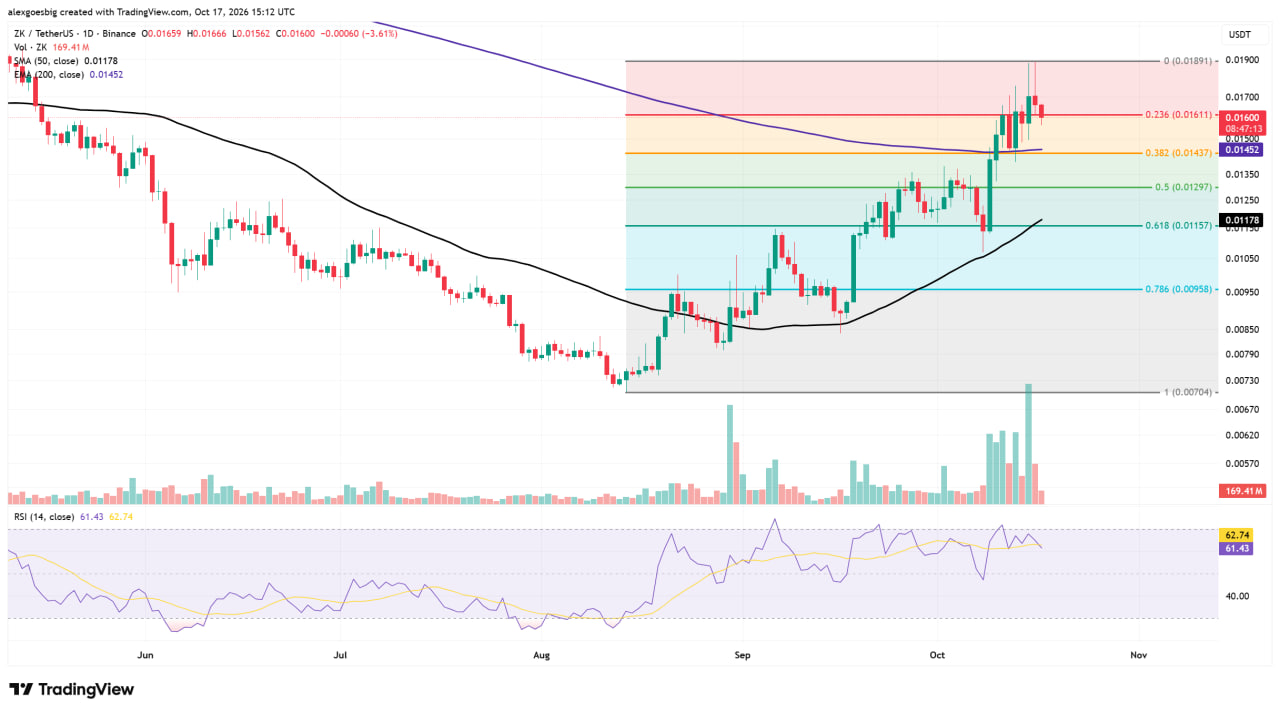
The top of the move tells a different story. Long upper wicks at $0.0175 and $0.0189 mean the price pushed higher during the day and then got sold back down. The heaviest trading volume of the whole rally came on the day ZK touched $0.0189 and reversed, which points to large sellers waiting at that level. The RSI, a gauge of buying strength, has slipped to 61 from the low 70s, and its peaks have flattened while the price kept rising. Buyers are still in control, but each push is weaker.
ZK/$USDT price ladder · daily chart
$0.0189
Resistance
This week’s high, where the heaviest selling appeared
$0.0175
Resistance
Several daily candles rejected here
$0.0161
Testing now
First support, with the price ($0.0160) sitting right on it
$0.0144-$0.0145
Key support
The 200-day average and a common pullback level meet here
$0.0130
Support
Top of the late-September trading range
$0.0116-$0.0118
Last line
The rising 50-day average
The $0.0144-$0.0145 zone decides what happens next. A dip into it on lighter volume than the rally, followed by a bounce, would keep the breakout alive and set up another attempt at $0.0175-$0.0189. A daily close back below the 200-day average would turn October’s move into a failed breakout, with $0.0130 the next likely stop. ZK also held its breakout even as a liquidation wave pushed Bitcoin under $81,000 this week. Saturday’s red candle is forming on much lighter volume than last week’s green days, which so far looks more like a pause than a wave of selling.
About 10 billion ZK tokens are still waiting to enter the market
Only around 52% of ZK’s 21 billion maximum supply circulates, according to market data aggregators, which leaves roughly 10 billion tokens to be released over time. Every recovery has to absorb that extra supply, whatever happens with the technology. On the development side, the next signals worth watching are outside teams reproducing ZKsync’s results on ETHproofs and the first published formal verification work Buterin asked for. Those would show whether Airbender Prime is ready for Ethereum itself, or only fast.
Read the full article here