


 Market Data

SBI Shinsei Bank is reportedly offering crypto deposit rewards to customers, with vouchers worth 20% of their interest payments redeemable for BTC, ETH, or $XRP through SBI VC Trade.
A three-month campaign launched on June 10, with a broader rollout planned for fall, covering ordinary deposits and time deposits from three months to five years, roughly 4.33 million individual accounts.
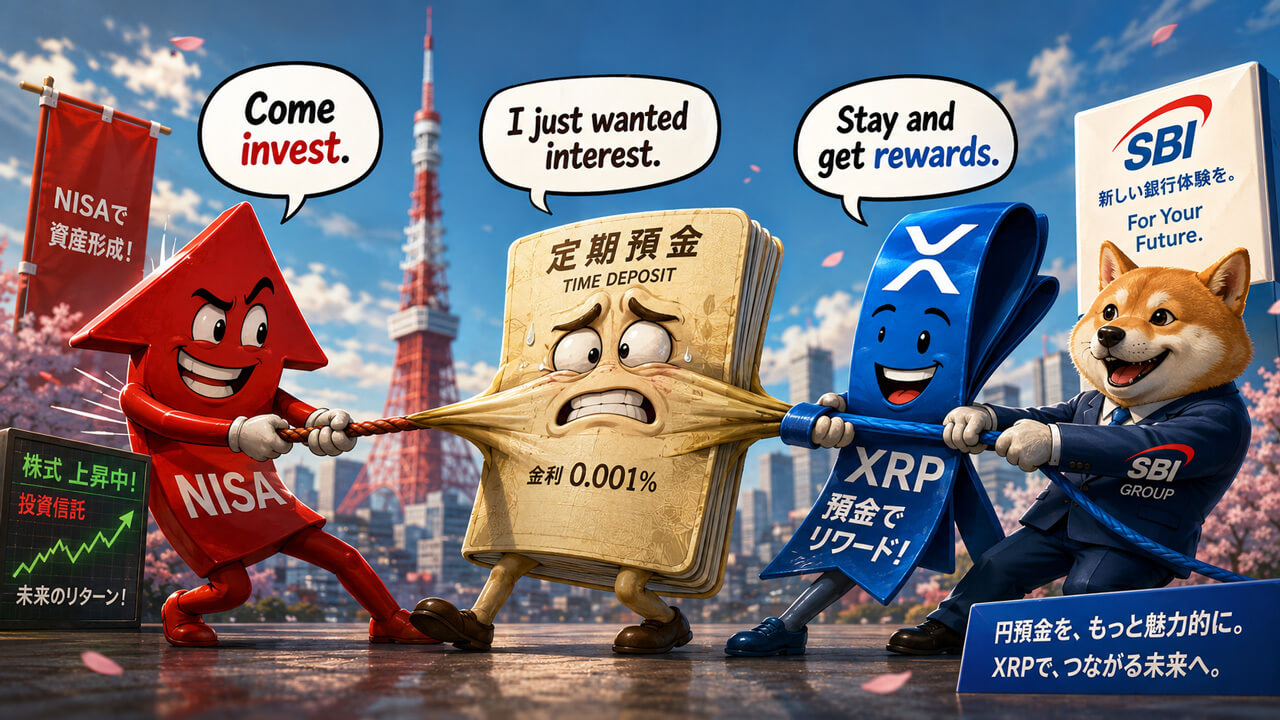
The mechanics reveal SBI using digital asset vouchers to make a conventional yen deposit stickier at a moment when Japanese savers have real alternatives for the first time in decades.
The Bank of Japan’s policy rate now sits at 0.75%, the highest level in decades, with three board members on record in favor of 1.0%.
A Reuters poll published June 10 found that 94% of economists expected the BOJ to raise the rate to 1.0% by the end of June, with over 75% projecting 1.25% by the fourth quarter.
Japan’s loan-to-deposit ratio reached 65.7% by September 2025, its highest point since March 2020, as banks face more domestic lending demand. NISA investment accounts reached 28.26 million, with cumulative purchases totaling roughly $442 billion by the end of 2025, already surpassing the government’s $349 billion target for 2027.
Together, these numbers describe a deposit market where banks can no longer assume household cash will sit still, and where the competitive logic demands something beyond a marginally better rate.
That makes the campaign less a standalone crypto promotion and more a test case in Japan’s deposit competition.
The mechanics reveal the motive
Japan’s household financial assets stood at approximately $14.65 trillion at end-2025, with $7.10 trillion held in cash and deposits, compared with 10% in the US and 35% in the UK.
For decades, zero rates gave banks captive depositors in the form of savers with nowhere better to go and no reason to move. Rising rates, tax-advantaged investing through NISA, and recovering equity markets have changed the arithmetic.
Deposits are now a product battlefield, and banks like SMFG and MUFG are bundling banking, securities, and payments to hold retail funds inside their groups.
SBI’s response to that pressure is to keep the deposit in yen, pay interest in yen, and offer crypto as an optional voucher redeemable only through SBI VC Trade, a condition that reflects the product’s architecture.
Customers who want the crypto reward must open an SBI VC Trade account, which converts bank deposits into a customer-acquisition funnel for the group’s crypto exchange.
The structure borrows directly from credit card rewards and airline miles by layering a small, high-perceived-value perk onto a low-margin financial product to make switching feel costly and cross-selling feel natural.
A $6,231 one-year deposit at 1.0% earns roughly $50 in net interest after Japan’s standard 20.315% withholding. The 20% crypto voucher on that interest amounts to approximately $10, or about 16 basis points of principal.
At the same rate, the three-month deposit of $1,850 comes to around $0.75. At those levels, the reward functions as a customer-acquisition coupon priced to move depositors through a funnel at a cost well below what raising deposit rates across the entire book would require.
Three campaigns on one architecture
In September 2025, SBI VC Trade and SBI Shinsei ran a campaign offering eligible customers $6 in $XRP vouchers, plus a share of $623,000 in $XRP, contingent on opening an SBI Hyper Yokin account and meeting balance requirements.
In February 2026, SBI Shinsei ran another campaign offering up to $124 in $XRP vouchers on six-month PowerDirect yen time deposits, with SBI VC Trade framing the program explicitly as a way to “experience $XRP” through conventional deposits.
A $62,300 example deposit earned roughly $174 after tax, plus a $62 $XRP voucher, with the voucher exceeding 20% of the interest, reflecting a campaign focused on tiers.
SBI’s tokenized retail bond used the same logic in parallel in February 2026, with $XRP vouchers serving as a one-time rebate that required an SBI VC Trade account.
SBI Ripple Asia, a joint venture between SBI Holdings and Ripple, has positioned $XRP within SBI’s group infrastructure since its founding. In these campaigns, $XRP serves as a redeemable reward object chosen because it is already familiar within SBI’s reward architecture and incurs no additional integration cost for the group.
Two ways this plays out
If Japanese depositors prove more conservative than the reward design assumes, preferring cash bonuses over crypto vouchers as rivals compete on headline rates, activation stays modest.
At 0.5% to 1% redemption across 4.33 million eligible accounts, SBI converts roughly 22,000 to 43,000 new exchange customers. The program stays as a promotional layer, and $XRP retains its role as a marketing asset with no measurable effect on exchange volumes or token demand.
If crypto rewards prove effective at a lower cost than competing on rates, and a meaningful share of new exchange customers become repeat users of SBI’s cards, securities, and broader financial products, the calculus shifts materially.
At 7% to 12% redemption, SBI generates between 303,000 and 520,000 SBI VC Trade activations.
At that scale, the proof SBI is actually building toward is whether crypto-linked rewards can function as a standing retention layer across deposits, bonds, and securities simultaneously, establishing crypto-as-loyalty-infrastructure as a repeatable group-wide model.
The actual prize
Japan’s banking groups are competing to own the full financial relationship with the country’s household savers: deposits, investments, brokerage, cards, and crypto exposure.
SBI’s voucher program is one entry into that contest, keeping the deposit conventional, the interest conventional, and the crypto appearing at the edge as a hook designed to pull customers one step deeper into the group.
Whether that hook is strong enough to work depends on whether Japanese savers find crypto upside compelling enough to act on a $1 voucher.
SBI bets the distinction between a crypto-native product and a crypto-flavored one stays invisible to customers and defensible to regulators.
Read the full article here